
About Tagnawa
Recovery can be a pathway to transformation.
Recovery shouldn’t mean returning communities to the same conditions that made them vulnerable in the first place.
For Tagnawa, recovery is an opportunity to address what lies beneath a crisis and build toward something stronger, more equitable, and community-led.


Our Story
How we started
Tagnawa was established in response to a documented gap in disaster recovery services for Filipino survivors of the Lahaina fires. Filipinos comprise a significant part of Lahaina’s community, yet in the immediate aftermath of the fires, many survivors were not being reached by mainstream recovery systems because of language barriers, immigration status concerns, and culturally inappropriate service delivery.
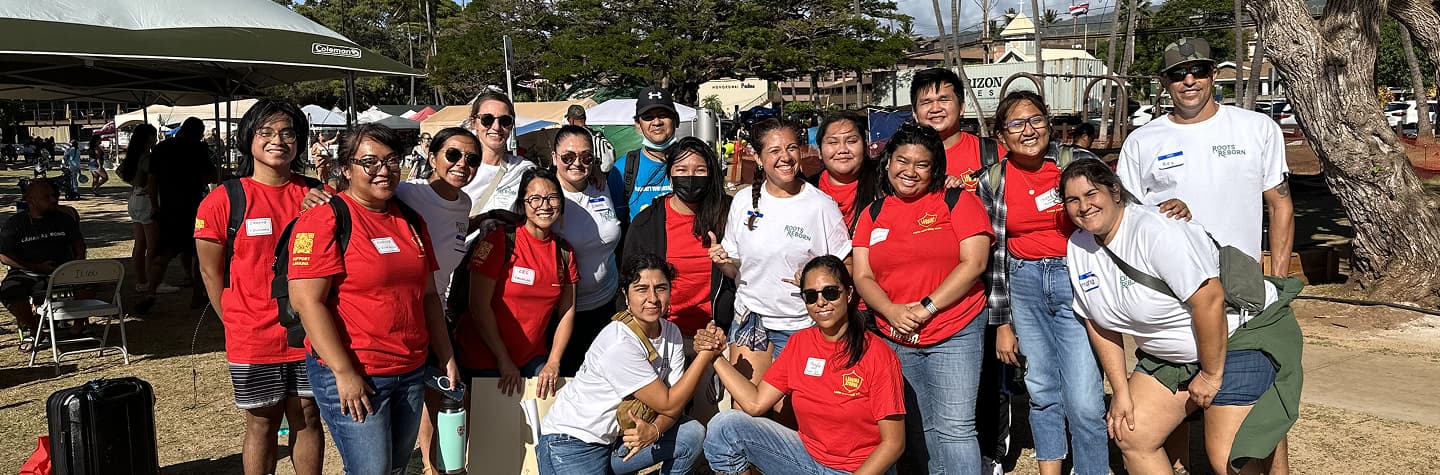
What began as an informal network of community volunteers from Oʻahu and Maui grew through family, friendship, and trust. Volunteers helped neighbors navigate complex aid systems, interpret information, find resources, and respond to needs that established disaster recovery infrastructure was not equipped to meet.
From grassroots to nonprofit
Tagnawa Hawaiʻi formally incorporated as a 501(c)(3) nonprofit organization to institutionalize and scale its disaster recovery work. This change has enabled Tagnawa Hawaiʻi to move beyond crisis response and into comprehensive recovery work, including research, policy design, and systems advocacy.


Our Mission
Turn recovery into lasting change.
Tagnawa Hawaiʻi is a mom-led, on the ground organization that exists to advance gender, immigrant, and environmental justice through community-led research, intersectional advocacy, and culturally-rooted disaster recovery. We serve vulnerable communities long excluded from mainstream relief and policymaking, including Filipinos, immigrants, women and girls, and gender nonconforming individuals. We provide trauma-informed support, educational tools and workshops, and a platform for collective action. We do not treat crises as isolated events. We aim to dismantle systemic inequities by addressing the underlying conditions such as poverty, discrimination, and dispossession so that recovery becomes a pathway to lasting structural transformation.

Our Vision
A Hawaiʻi where communities have the power to care for their own.
We envision a Hawaiʻi where people live with dignity, safety, and self-determination. We see a future where our communities engage their own strength, knowledge, and ingenuity to collectively respond to future disasters. By leaning into intergenerational knowledge, practices, and ways of relating, we seek to build collective care and mutual aid systems to replace structures of charity and control. In this future, our islands are healthy, accessible, and abundant for all who call them home, and we stand in solidarity with Native Hawaiian sovereignty as part of our shared liberation.
Our Values
Our work is grounded in Filipino and Ilokano specific cultural values, which guide our relationships, decisionmaking, and how we organize, advocate, and heal together.
Tagnawa (Mutual Aid & Collective Responsibility)
We practice cooperative action and reciprocity, rejecting individualism and transactional charity. We show up for one another because our liberation is intertwined.
Kapwa (Shared Peoplehood & Relationality)
We recognize that we are not separate from our communities; we are part of a collective whole. Our work is built on trust, connection, and the belief that wellbeing is communal, not individual.
Wayawaya (Freedom & Self-Determination)
We center the leadership and voices of those most impacted, ensuring that our communities define their own futures. We resist top-down solutions and work toward genuine autonomy
Aloha ʻĀina (Love for the Land & Environmental Justice)
As diasporic Filipinos with our own traditions of caring for and relating to the land, we honor the land and waters of ka paeʻāina o Hawaiʻi and the principles of aloha ʻāina. We support Native Hawaiian sovereignty and fight alongside Indigenous communities for #LandBack.
Intersectional Justice
We name and confront the overlapping systems of oppression, including racialized capitalism, colonization, patriarchy, and environmental racism, that shape our lived realities. We refuse single-issue approaches and work across movements for collective liberation.